

In Brief
Die casting uses two fundamentally different processes: hot chamber and cold chamber die casting.The material determines which process is used: Hot chamber die casting is used for low-melting metals such as zinc and magnesium (approx. 380–480 °C), where the casting unit sits directly in the molten bath — this enables the shortest cycle times, long tool life, and the highest precision for delicate components. Cold chamber die casting is mandatory for aluminum (approx. 600–700 °C), as liquid aluminum attacks steel; here, the melting furnace and casting unit are separated, which means longer cycle times and higher energy consumption, but enables lightweight, large-volume, and highly durable components.
In the industrial production of die-cast parts, hot and cold chamber processes are two methods for cost-efficiently manufacturing lightweight metal components. The processes differ in terms of material, process control, and technical and economic requirements. This guide explains the differences between the two processes. We show you the clear advantages and disadvantages so you can determine which process is suitable for your components.
Quick Check: Comparison Table
| Criterion | Hot Chamber Process | Cold Chamber Process |
| Materials | Zinc, Magnesium | Aluminum, Brass, Copper alloys |
| Melting Point | Low (approx. 380–480 °C) | High (approx. 600–700 °C) |
| Cycle Time | Very short (high output rate) | Longer (due to external dosing) |
| Tooling | High-alloy steel (very durable) | High-alloy steel (high stress) |
| Cost-Effectiveness | Ideal for series and mass production | Efficient for large aluminum components |
Hot Chamber Die Casting Process
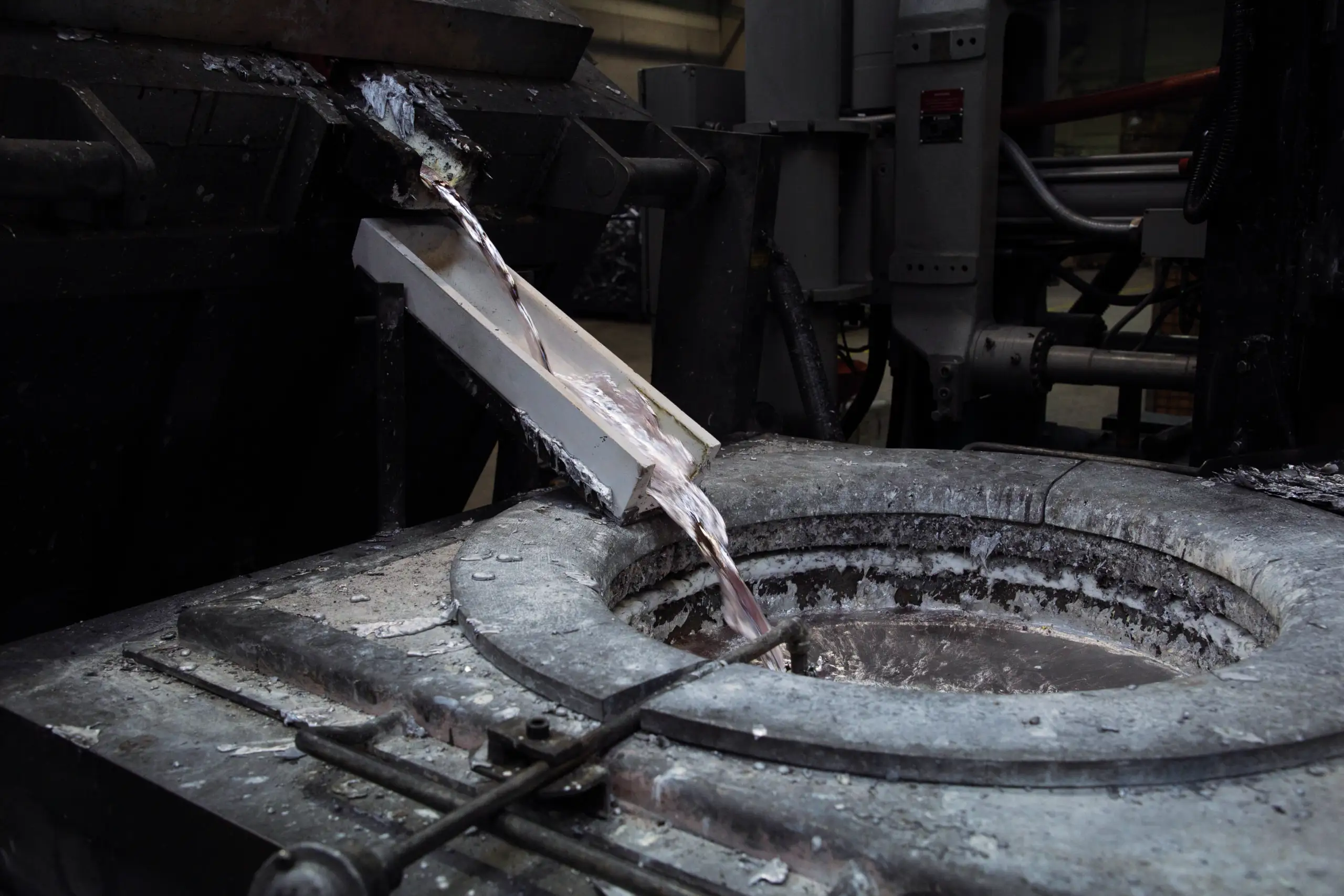
The hot chamber process is primarily used for zinc die casting die casting and magnesium die casting, because these materials are not aggressive toward the casting unit. Therefore, the casting unit sits directly in the liquid melt. The alloy remains permanently in a liquid state and is pressed into the mold under high pressure by a plunger.
Advantages of Hot Chamber Die Casting
In the hot chamber die casting process, the process temperature is low at under 500 °C. This low temperature protects the casting unit. In practice, this leads to an above-average tool life. Additionally, the process offers several other advantages:

1. Longer Tool Life and High Cost-Effectiveness
The low melting temperature and the low abrasiveness of zinc in contact with steel lead to slower tool wear. This extends tool life and often eliminates costly follow-up investments. This makes the process more economical, especially for large batch sizes.
2. Short Cycle Times and High Productivity
The lower melting temperatures ensure rapid solidification of the alloy. This shortens cycle times compared to aluminum die casting. The production rate per machine is higher. In manufacturing, this significantly reduces the unit costs of components.
3. Precision, Material Properties, and Design Freedom
Zinc die casting offer excellent mechanical properties such as strength, toughness, and elasticity. This produces thin-walled components with tight tolerances. Additionally, the hot chamber process allows the production of complex geometries with high dimensional accuracy and a smooth surface. This is ideal for delicate components or visually demanding design parts, such as for the furniture and hardware industry.
Conclusion
The hot chamber process is the best choice for small to medium-sized components made of zinc or magnesium. It meets the highest demands for precision, surface quality, and cost-effectiveness. The process combines short cycle times with high dimensional stability and is therefore more efficient than the cold chamber process.
Disadvantages of Hot Chamber Die Casting
Hot chamber die casting is well suited for zinc and magnesium alloys, but it also has several disadvantages. Therefore, when selecting the appropriate die casting process, pay attention to the following points:

1. Limited to Low-Melting Alloys
The hot chamber process exclusively processes low-melting alloys such as zinc and magnesium. It cannot process aluminum alloys. The reason is that the liquid aluminum melt attacks the plunger of the casting unit, causing extremely high wear, which rules out aluminum for this process.
2. Wear on the Casting Chamber
Due to Constant Melt Contact The direct integration of the casting unit into the molten bath leads to permanent thermal and chemical stress. For zinc alloys, this plays a minor role. However, long production times or insufficient maintenance can wear out the piston rings, the gooseneck nozzle, and the nozzle tip. The piston rings and gooseneck nozzle wear the most, as the melt flows through a thin cross-section at high speed. Additionally, the pistons move up and down very frequently due to the short cycle times.
3. Limited Component Sizes and Material Variety
The process is primarily suited for smaller, delicate components. For large-volume or mechanically highly stressed components, it reaches its limits: the reason is the higher density and consequently heavier weight of zinc. For lightweight construction, such as chassis components in the automotive sector, zinc die casting in the hot chamber process is therefore not the first choice.
Conclusion
The hot chamber process is not suitable for aluminum components. The casting unit is always in contact with the liquid melt, and this thermal and chemical stress leads to higher wear. The process also has disadvantages for large-volume or mechanically highly stressed components. Zinc is often too heavy for these components due to its high density.
Cold Chamber Die Casting Process
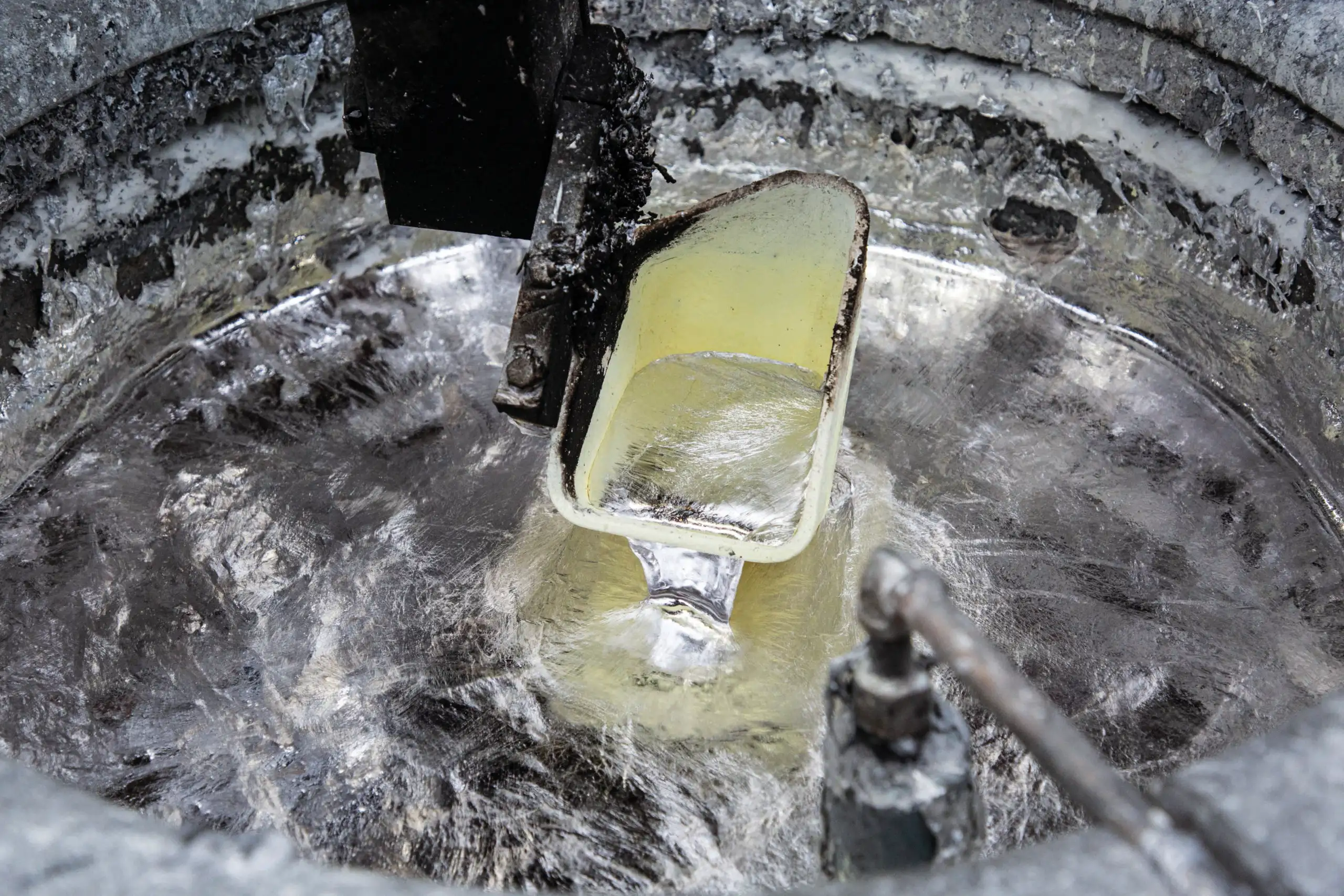
The cold chamber process is primarily used for aluminum die casting. In this process, the casting unit and the melting furnace are separated. First, the aluminum alloy melts in a furnace. A dosing robot then fills the liquid aluminum into the casting chamber, after which the cold chamber machine injects it into the mold under high pressure.
Advantages of Cold Chamber Die Casting
The cold chamber process is used for aluminum alloys with melting temperatures of up to 700 °C. Aluminum is lightweight, strong, and easy to machine. The cold chamber process itself also offers several advantages:
1. Processing of Aluminum Alloys and Large Components
The cold chamber process is necessary to process aluminum alloys in die casting. Aluminum attacks the steel in the plunger, so the hot chamber process doesn’t work here. This process solves the problem by spatially separating the melting furnace and casting unit. This allows the production of large-volume components that withstand high mechanical and dynamic loads.
2. High Precision, Series Consistency, and Low Post-Processing
The cold chamber process enables the production of thin-walled, complex components with high dimensional accuracy and dimensional stability. Near-net-shape casting requires less post-processing, which reduces costs. Even at medium and large quantities, component quality remains consistently the same. Smooth surfaces and very precise dimensions are ideal for manufacturers and suppliers requiring large batch sizes
3. Low Density and Light Weight
A major advantage is the use of aluminum alloys. Compared to zinc, they have a lower density and therefore weigh less. This allows the production of large-volume components without them becoming too heavy. This property makes aluminum die casting ideal for lightweight construction, as lower weight increases energy efficiency. This doesn’t work with zinc die casting, neither technically nor economically.
Conclusion
Without the cold chamber process, we couldn’t use aluminum alloys in die casting. We use it to produce large-volume components that are lightweight yet highly dimensionally stable, especially in high quantities. This is not possible with zinc at these dimensions.
For aluminum die casting, we guarantee a tool life of up to 100,000 shots per tool. Our experience shows that for simple, contour-dependent components, 120,000 to 150,000 shots are also possible. Multi-cavity tools with multiple cavities achieve very high output volumes, so the tool pays for itself quickly.
The actual tool life depends heavily on the component requirements. If critical dimensions are machined afterwards, higher output is possible. It’s different for visible or functional surfaces used without post-processing: here, the tools are exposed to higher stress. Wear on contour-defining areas, such as replaceable cores, then requires earlier maintenance measures.
Disadvantages of Cold Chamber Die Casting
The cold chamber process is essential for aluminum die casting. Compared with the hot chamber process, however, it has several disadvantages affecting cycle time, energy efficiency, and tool wear. Pay attention to the following disadvantages:
1. Higher Technical Effort Due to External Dosing
In cold chamber die casting, a dosing robot transports and doses the charge from the melting furnace into the casting chamber. This additional process step requires dosing robots, ladle systems, or ladle arms. For large batch sizes, this can be economically compensated, but the initial technical effort remains higher.
2. Longer Cycle Times Due to Physically Determined Process Pauses
The aluminum alloy determines the cycle time in the cold chamber process. After injection, the material solidifies under high pressure in the mold. Only then does the mold open again. The high melting temperature (approx. 700 °C) of aluminum therefore extends the cycle time, which is further extended by large-volume or thick-walled components. The process takes significantly longer than hot chamber die casting.
3. Increased Energy Demand
Due to Open Melt Handling Aluminum must be heated to approximately 700 °C to become liquid. The liquid melt then radiates a great deal of heat. In the cold chamber process, the melt is taken openly from the furnace and dosed into the tool. This causes energy losses, and additionally, the melting furnace, dosing system, and casting chamber must be heated separately. Therefore, this process consumes more energy than the hot chamber process.
Conclusion
The cold chamber process is without alternative for die casting aluminum alloys. However, this process is technically more complex, more maintenance-intensive, and consumes more energy than the hot chamber process. Modern process automation, intelligent tempering systems, and better tool design can largely compensate for these disadvantages.

Materials Compared: Melting Points and Chemical Reactivity
The choice between cold and hot chamber processes is primarily determined by the melting of the metal. While zinc has a low melting point and does not attack the steel of the casting unit, aluminum is highly reactive. Liquid aluminum would immediately dissolve the casting unit in the hot chamber bath. Therefore, aluminum requires the cold chamber process to minimize thermal stress on the machine and to ensure the service life of high-alloy steel components in the manufacturing industry.
Turbulent Filling
In both hot and cold chamber processes, the molten metal is injected into the mold under high pressure. The molten metal hits the mold walls at high speed, causing “turbulent flow” in the mold cavity. This turbulent flow traps small oxygen bubbles in the melt.
This leads to porosity — small voids in the microstructure. Technically, this cannot be completely avoided. In aluminum die casting, this effect is further amplified by the chemical reactivity of the aluminum melt with the steel components of the casting unit. However, intelligent process control significantly reduces pore formation and limits it to a minimum.
Vacuum Die Casting
In addition to conventional mold venting, vacuum technology helps significantly reduce porosity in die casting. The system extracts the air from the mold cavity before and during the inflow of liquid melt. This means fewer oxygen bubbles remain trapped in the melt. This improves the microstructure density and the mechanical properties of the die-cast parts, making them weldable and heat-treatable.
Additionally, vacuum and peripheral devices can be integrated into suitable tools that specifically support the process. However, vacuum technology requires careful calibration. If the system is not optimally designed, unwanted particles or contaminants enter the component. With our many years of experience in process control, we virtually eliminate the risks of vacuum die casting.
Conclusion: Which Process for Which Project?
The choice of process depends on the material. For aluminum, only the cold chamber process is suitable, due to the high melting temperature and the strong reaction with steel. Zinc and magnesium, on the other hand, are processed in the hot chamber process, because these materials have lower melting temperatures.
A true choice between hot and cold chamber processes doesn’t exist, as the material dictates the process. The comparison becomes interesting when both aluminum and zinc are options for a component. In this case, factors such as weight, dimensional accuracy, tool life, and surface quality play a role alongside mechanical properties.
Choose the hot chamber process when:
- You need small to medium-sized components with high precision
- Zamak 3, Zamak 5, or magnesium are viable materials
- You aim for short cycle times and low unit costs in series and mass production
- Delicate geometries, tight tolerances, or smooth surfaces are required
Choose the cold chamber process when:
- Aluminum is the desired material
- Large-volume or mechanically highly stressed components are required
- Lightweight construction and low weight are decisive (e.g., automotive, aerospace)
- You are planning medium to large series and mass production
Aluminum die casting in the cold chamber process offers advantages in lightweight construction and for large-volume, durable components. Zinc die casting in the hot chamber process excels with very precise dimensions and delicate structures. In direct comparison, tools last approximately twice as long here.
Do You Have Questions About Either Process?
Our expert team is happy to advise you on all questions regarding aluminum and zinc die casting. In recent years, we have supplied numerous OEMs, suppliers, and machine builders with die-cast components.
Whether technical consulting, feasibility analysis, or a customized quote for your application: we are always available as your contact. Reach out to us without obligation. We look forward to your inquiry.

Frequently Asked Questions (FAQ)
The hot chamber process is used for metals with a low melting point such as zinc (Zamak 3, Zamak 5) and magnesium. The cold chamber process is mandatory for aluminum as well as copper and brass alloys.
Aluminum reacts chemically with iron and would dissolve the permanently submerged steel casting unit in a very short time. Additionally, the melting temperatures are technically too high for this process.
The hot chamber process is more cost-efficient, as cycle times are significantly shorter due to the integrated casting unit and less energy is lost through heat dissipation. The cold chamber process incurs higher costs per unit due to the slower, external dosing process and the high energy demand for melting aluminum.
Both processes are prone to gas pores due to turbulent mold filling, which can affect microstructure density. However, through the use of vacuum technology and optimized process control, porosity can be reduced to a minimum in both processes to guarantee the highest component quality.